
Your website can rank on Google’s first page and still be missing from ChatGPT’s answers or Google AI Overviews. Improving your AI search visibility requires more than traditional rankings. You need to make sure the right pages are accessible, relevant to the question, useful enough to stand out, and supported by credible information.
Imagine you run a software company. Your comparison guide ranks well for a valuable search term, and your team has spent months improving its content. Then a potential customer asks ChatGPT to compare the leading tools in your category. Three competitors appear, but your product doesn’t.
What went wrong?
It might be a technical problem. Your content might not address the customer’s actual question. Competitors might provide better evidence, or your business might be poorly represented across the web. There is also a simpler possibility: the particular AI-generated answer doesn’t select your page, even though it is a good search result.
These situations require different solutions.
Google’s official guidance on generative AI search confirms that traditional SEO remains important. OpenAI, meanwhile, provides separate controls for managing how its search crawler accesses websites. Neither platform promises that meeting technical requirements guarantees a citation.
This guide explains how to identify the problem, prioritize fixes, analyze competitors, and measure whether your changes make a difference.
Table of Contents
What Does It Mean When Your Website Is Invisible in AI Search?
AI search visibility describes how often your website or brand appears in answers generated by AI-powered search experiences. It can include website citations, brand mentions, product recommendations, and visits from AI platforms.
These outcomes are related, but they are not interchangeable.
Your brand is not mentioned
When someone asks an AI assistant to recommend a service or explain a topic, your company may not appear at all.
This could indicate that the system has insufficient relevant information about your business, that competing sources better answer the question, or that your company simply isn’t selected for that response. One missing mention cannot establish which explanation is correct.
Your website is not cited
An AI answer can mention a company without linking to its website. It can also cite an independent review, a comparison article, or another publication that discusses the company.
This distinction matters because a brand mention does not necessarily send visitors to your website.
Your website is cited, but competitors receive the recommendations
A page may support one part of an answer without being the source of the final recommendation.
For example, an article about software integrations might be cited when an assistant explains technical compatibility, while a competitor is recommended for overall suitability. Your content may be useful, but it serves a different part of the customer’s decision.
Your visibility differs between platforms
ChatGPT Search and Google AI Overviews do not always produce the same answers or source lists. A page that appears in one experience may be absent from another.
Therefore, don’t treat AI visibility as a single universal ranking. Track the platforms, questions, brands, and cited URLs that matter to your business.
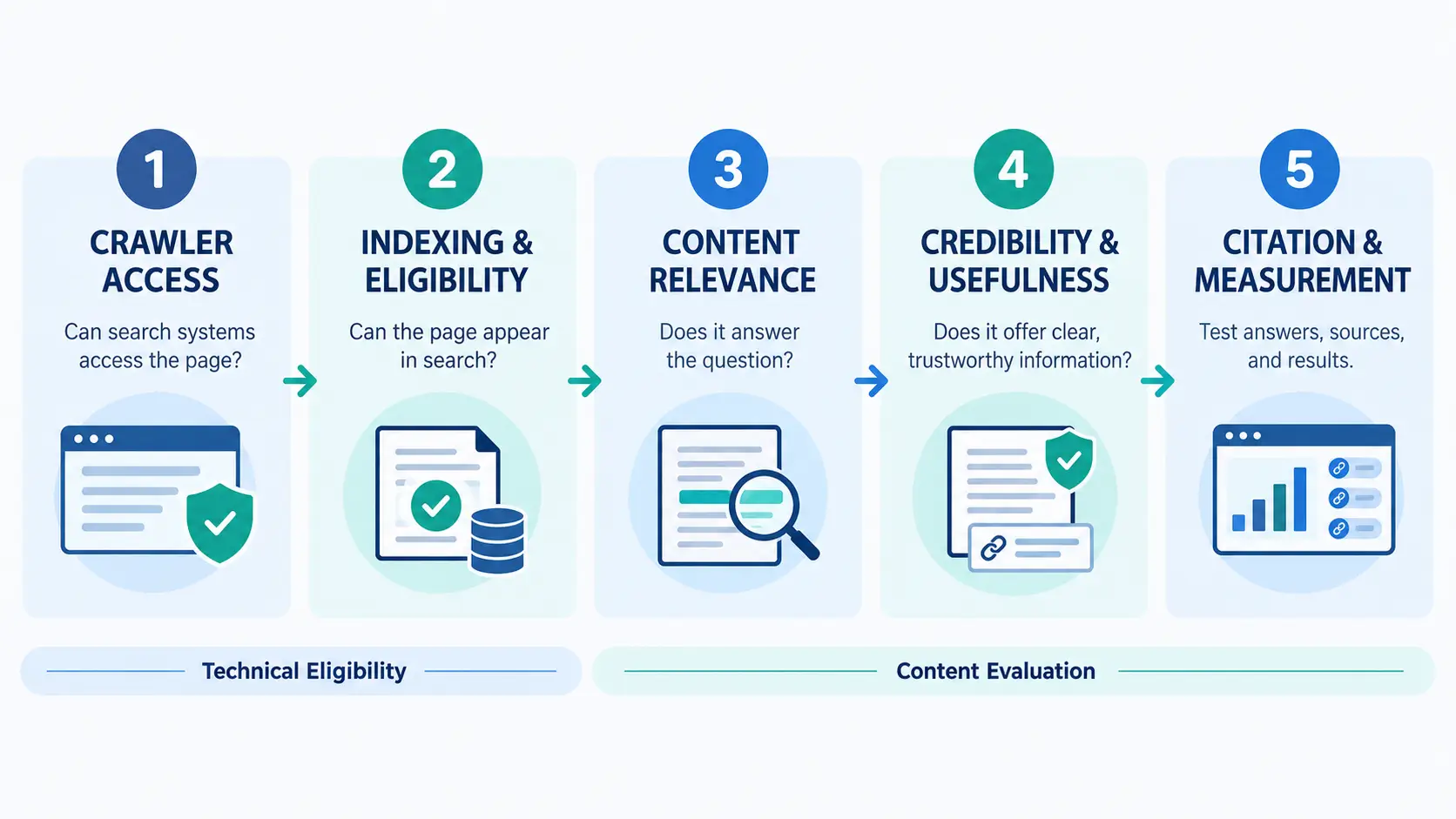
How ChatGPT Search and Google AI Overviews Differ
Both experiences can connect people with useful websites, but their technical checks and reporting options differ.
| Area | ChatGPT Search | Google AI Overviews |
|---|---|---|
| Initial technical check | Inspect OAI-SearchBot access and server restrictions | Check Google indexing and eligibility for a search snippet |
| Important documentation | OpenAI crawler guidance | Google AI search guidance |
| Useful tools | robots.txt, server logs, CDN logs, and repeatable prompt tests | Google Search Console and URL Inspection |
| Visibility measurement | Record cited URLs, brand mentions, and identifiable referral visits | Use Search Console’s Generative AI performance reporting and analytics |
| Important limitation | Crawler access does not guarantee a citation | Indexing eligibility does not guarantee an AI Overview appearance |
Google’s technical requirements for supporting links in AI Overviews include being indexed and eligible to appear in Search with a snippet. OpenAI separately identifies OAI-SearchBot as the crawler used to surface websites in ChatGPT Search. See the Google documentation and OpenAI’s crawler documentation.
The practical lesson is simple: run separate checks for each platform instead of assuming that success in one automatically means success in another.
8 Reasons Your Website May Not Appear in ChatGPT or Google AI Overviews
Start with technical eligibility, then examine content, authority, and measurement. Each problem calls for a different fix.
1. AI crawlers or search crawlers cannot access your content
If a relevant crawler cannot access a page, that page may never become a candidate for the corresponding search experience.
Common causes include restrictive robots.txt rules, CDN or firewall restrictions, access controls, server errors, and pages that return different responses to legitimate crawlers.
For ChatGPT Search, pay particular attention to OAI-SearchBot. OpenAI distinguishes it from GPTBot, which is used to crawl content that may be used to train its models. Allowing one does not automatically mean the other is allowed.
How to check: Review your robots.txt file, server responses, and firewall or CDN rules. Where possible, inspect server logs and verify crawler requests against the published information for the relevant crawler.
How to fix it: Correct accidental blocks and allow the crawler if you want the corresponding search service to discover your pages. Respect your organization’s content-use preferences when making this decision.
Mistake to avoid: Changing unrelated SEO settings before confirming that the relevant crawler can reach the page.
2. Your pages are not indexed or eligible for retrieval
A page can exist on your website without appearing in a search index.
Accidental noindex directives, incorrect canonical tags, weak internal linking, duplicate URLs, and poor URL discovery can all create technical problems that deserve investigation.
Google’s requirements are especially clear: a page must be indexed and eligible to appear in Search with a snippet to qualify as a supporting link in its AI features.
How to check: Use Google Search Console’s URL Inspection tool to examine important URLs. Check the declared and selected canonical URLs, indexing status, sitemap inclusion, internal links, and any restrictive snippet directives. Check indexing in other relevant search systems separately.
How to fix it: Resolve conflicting canonical tags, remove accidental indexing restrictions, strengthen internal links, and submit a clean sitemap containing canonical URLs that should be indexed.
Mistake to avoid: Assuming that because your homepage is indexed, every service page or blog post is also eligible.
3. Your content repeats what competitors already publish
A page can cover every expected heading and still provide little that distinguishes it from existing results.
Imagine ten articles explaining that businesses should improve crawlability, publish helpful content, and build authority. If your page repeats the same advice without showing how to diagnose a problem, readers have little reason to choose it over another result.
The same weakness limits its practical value for AI search.
How to check: Compare your page with relevant competitors. Look for original evidence, useful examples, specific explanations, expert contributions, and questions that competitors have not adequately answered.
How to fix it: Add a real website audit, a documented test, an original comparison, or a useful troubleshooting example. Explain what you observed, how you verified it, and what the findings mean.
Mistake to avoid: Rewriting competitor articles sentence by sentence and calling the result original research.
4. Your page does not answer the user’s question clearly
A detailed article may contain the correct answer but make readers work too hard to find it.
For example, a reader asking how to allow ChatGPT Search to access a website needs to understand which crawler matters and where to check it. A long introduction to the future of search doesn’t help them complete that task.
How to check: Read your page as someone arriving with one specific question. Can the reader find a direct answer, understand the conditions under which it applies, and see how to verify it?
How to fix it: Start each major section with the central answer. Follow it with the reasoning, evidence, relevant exceptions, and practical steps.
Use descriptive headings, meaningful examples, concise explanations, and comparison tables where they genuinely improve clarity.
Mistake to avoid: Treating short paragraphs or a prescribed number of words per section as a guaranteed AI citation technique. Google’s guidance states that there is no ideal page length for generative AI search.
5. Your website lacks clear topical and entity context
Search engines and AI systems need enough information to interpret what a business does and why a particular page is relevant.
Suppose a company publishes articles about SEO, web development, paid advertising, finance, and healthcare without clear relationships between the subjects. Its website may offer little clarity about its main expertise.
A focused website with well-explained services, relevant supporting content, and identifiable authors gives readers a clearer picture of the business.
How to check: Review your homepage, About page, service pages, author profiles, and internal links. Ask whether a new visitor can quickly identify what your business does, whom it serves, and what expertise supports its claims.
How to fix it: Clarify your core services, publish useful content around related customer questions, and link supporting articles to relevant main pages. Keep business information and author details consistent.
Structured data can help describe a page’s content, but Google says no special schema markup is required specifically for generative AI search.
Mistake to avoid: Publishing large numbers of loosely related articles simply to make your website appear more comprehensive.
6. Competitors have stronger evidence or more relevant third-party references
Your website is not the only place where people learn about your business.
Independent reviews, expert commentary, relevant industry publications, credible comparisons, and reputable partner websites can all help establish a clearer public picture of a company.
Consider two software providers. Both claim to be easy to use, reliable, and suitable for small businesses. One also has detailed independent reviews, documented integrations, transparent pricing, and useful product comparisons. Prospective customers have more concrete information with which to evaluate that business.
This does not prove that a particular AI system will select it. It does illustrate why specific, verifiable information is more useful than repeated marketing claims.
How to check: Identify the third-party sources that appear when customers research your category. Compare the information available about your business with the information available about your competitors.
How to fix it: Earn relevant media coverage, contribute genuinely useful expert commentary, encourage honest customer reviews, and keep product or service details accurate across credible platforms.
Mistake to avoid: Buying artificial mentions or producing low-quality guest posts simply to increase the number of times your brand appears online.
7. Important information is difficult to access or understand
A page might technically load while still making its useful information difficult to retrieve or interpret.
Examples include key service details hidden in images, incomplete JavaScript rendering, confusing headings, inaccessible content, or important specifications buried inside interactive elements.
These problems can also affect human visitors, particularly people using assistive technology or browsing on mobile devices.
How to check: Inspect the rendered page and, where useful, its HTML source. Confirm that important information is available without unnecessary interaction and that headings, links, lists, and tables have clear meaning.
How to fix it: Put essential facts in accessible page content, use semantic HTML, provide descriptive headings, and make sure interactive elements work correctly.
Mistake to avoid: Assuming that every AI crawler reads pages exactly like a human browser. Test the actual technical requirements of the relevant platform.
8. You are measuring AI visibility incorrectly
AI-generated answers can vary with the question, the context, and the sources retrieved. A single screenshot cannot reliably establish whether your website has improved or declined.
Likewise, seeing your brand in one answer does not prove that you have broad AI search visibility.
How to check: Create a consistent set of realistic customer questions. Test them across relevant platforms and record whether your brand appears, which pages are cited, which competitors appear, and when the tests were run.
How to fix it: Establish a baseline, repeat the same tests over time, and combine those observations with platform reporting and identifiable referral traffic.
Mistake to avoid: Treating a one-time mention, a citation, a ranking, and a website visit as equivalent results.
How to Fix Your AI Search Visibility Problems Step by Step
The most efficient approach is to resolve access and eligibility issues first, then improve the content and evidence available to potential sources.
Step 1: Check the technical foundations. Inspect important URLs, crawler access, indexing, canonicalization, server responses, and snippet restrictions. Fix genuine blockers before rewriting content that may already be useful.
Step 2: Identify the questions your customers actually ask. Gather questions from sales conversations, customer support, keyword research, and competitor content. Separate informational questions from product comparisons, purchase decisions, and local searches.
Step 3: Improve the information on your most important pages. Make answers clear, verify claims, cite reliable sources, and include original observations. Improve existing pages where appropriate rather than automatically creating new ones.
Step 4: Strengthen the public evidence around your business. Clarify your expertise, improve useful third-party references, document products or services accurately, and ensure the business is described consistently.
Step 5: Measure, learn, and repeat. Re-run your test prompts, inspect the sources that competitors receive citations from, and track meaningful changes in citations, visits, and enquiries.
Do not assume that every missing citation requires more content. Sometimes the page is blocked. Sometimes the answer is already good enough, but another source is more relevant to the particular question.
Diagnosis determines the work.
How to Audit Competitors for AI Search Visibility
A useful competitor audit should reveal why competing pages are better candidates for particular questions, not merely what keywords they use.
Begin by building a fixed list of questions potential customers might ask. Include broad informational searches, comparisons between providers, product-specific questions, and purchase-related queries.
Run those same questions in ChatGPT Search and Google Search with AI Overviews, where available. Record the date and the exact wording of each question.
For each result, investigate four things.
First, identify the cited pages. Record whether the answer references a competitor’s homepage, service page, research article, comparison guide, or a third-party review.
Second, examine the reason those pages are useful. Do they offer specific evidence, transparent comparisons, clear product details, expert analysis, or a better answer to the question?
Third, identify the sources surrounding those competitors. Look for relevant industry publications, independent review sites, reputable directories, and other sources that provide information about the business.
Fourth, choose a gap you can genuinely close. If a competitor has a detailed comparison page and yours says little about the differences between products, improve the comparison. If the competing page contains original research that your page lacks, investigate whether you can produce relevant evidence of your own.
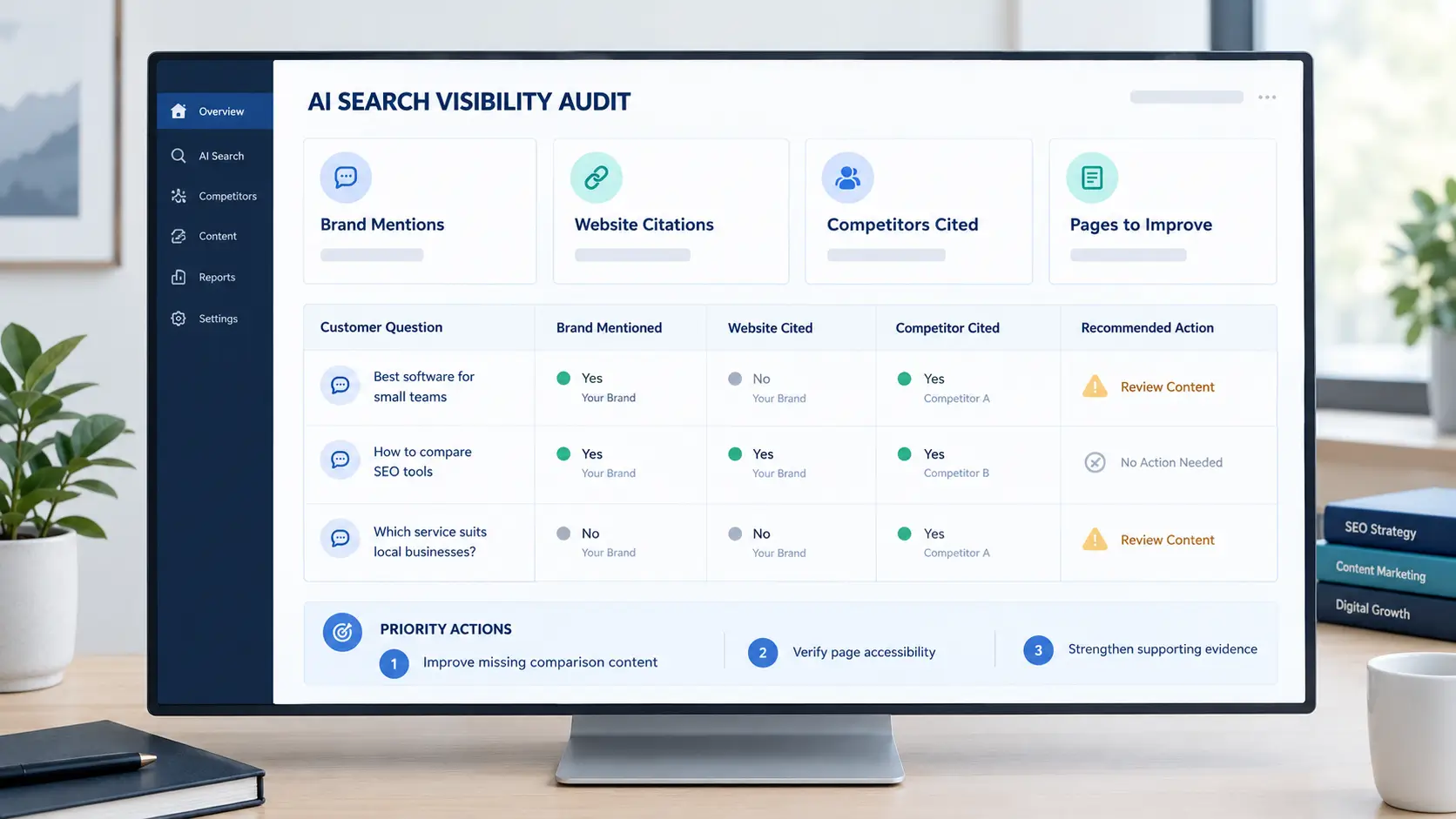
Keep a simple audit record with the question tested, the platform, your brand’s mention status, the cited URL, the competing source, and the action you plan to take.
Repeat the test consistently. AI-generated answers can change between runs, so record observations rather than treating every result as a permanent ranking.
The aim is not to copy the pages competitors publish. It is to understand what makes their information useful and then provide something more relevant, accurate, or complete for your audience.
How Local Businesses Can Improve Their Visibility in AI Search
Local businesses need to make it easy for people to understand what they offer, where they operate, and why a customer might choose them.
Consider a plumbing company serving several neighborhoods. Its homepage says that it provides professional plumbing services, but it gives little detail about emergency repairs, service areas, operating hours, or the jobs it handles.
A more useful website explains its services, locations, qualifications, availability, and pricing approach where appropriate. Visitors can decide whether the business fits their needs without having to guess.
Start with the following improvements:
- Keep your Google Business Profile accurate, including business categories, services, hours, and location details.
- Maintain consistent business names, contact information, and addresses across relevant platforms.
- Create useful service and location pages that answer real customer questions.
- Encourage genuine customer feedback and keep review responses professional.
- Explain what makes your business different using specific, verifiable details.
Avoid creating dozens of almost identical location pages that merely swap one city name for another. A local page should offer meaningful information about the service and the area.
These actions improve the information available to customers and search systems, but they do not guarantee that an AI assistant will recommend your business.
How to Measure AI Search Visibility Properly
Use several metrics because no single number explains the entire customer journey.
| Metric | What it tells you |
|---|---|
| Brand mention rate | How often your brand appears across a defined set of test answers |
| Citation frequency | How often your website is cited as a source |
| Share of citations | How frequently your website is cited relative to competitors in the same test set |
| Citation accuracy | Whether the cited page supports the answer correctly |
| AI referral sessions | How many visits arrive from identifiable AI platforms |
| Conversions or enquiries | Whether measurable business outcomes follow |
These metrics answer different questions. A high citation frequency does not automatically mean high traffic, and more visits do not necessarily mean more qualified leads.
For Google, use Search Console’s Generative AI performance reporting to examine impressions and the pages shown in its generative AI search and Discover features. Google announced that these reports were available to all websites worldwide from August 31, 2026. See the official announcement.
For Microsoft Copilot and other supported experiences, Bing Webmaster Tools provides an AI Performance report that reports citation activity and associated grounding queries. Its figures represent aggregated, sampled activity rather than a complete record of every AI answer.
For ChatGPT and other platforms, maintain a consistent prompt-testing record and monitor identifiable referral visits in your analytics platform.
Use these sources together. Search reporting, AI citations, website visits, and conversions describe different stages of visibility and should not be combined into one unsupported success score.
Common GEO and AI SEO Myths to Avoid
Myth 1: Ranking on page one guarantees an AI citation
It does not. Traditional rankings remain important, particularly for Google’s AI search features, but eligibility does not guarantee that a page will appear in an individual generated answer.
Myth 2: Adding llms.txt guarantees AI search visibility
Google’s official guidance says that llms.txt and similar files are not used by Google Search and do not improve or harm its search visibility. You can maintain such files for other systems that use them, but they are not a Google ranking shortcut.
Myth 3: Special schema markup guarantees citations
No special schema markup is required specifically for Google generative AI search. Appropriate structured data remains useful for supported search features, but it should accurately describe visible page content rather than serve as a promise of AI visibility.
Myth 4: Every article must be broken into tiny sections
There is no universal word count or required passage length for Google AI search. Use headings, paragraphs, and lists when they improve understanding. Write for the reader, not an imagined extraction formula.
Myth 5: More brand mentions always mean better visibility
A credible, relevant reference can be more useful than numerous low-quality mentions. Focus on accurate information, legitimate recognition, and sources that genuinely help customers understand your business.
Google covers these points in its generative AI optimization guidance.
Frequently Asked Questions
What is AI search visibility?
AI search visibility is the extent to which a website or brand appears in AI-generated search experiences. It can involve citations, brand mentions, product recommendations, and referral visits. Because these outcomes measure different things, businesses should track them separately rather than relying on one overall visibility score.
How do I get ChatGPT to cite my website?
Start by checking that OAI-SearchBot can access your important pages and that your server or CDN does not block relevant requests. Then improve the accuracy, relevance, and usefulness of your content. Monitor a consistent set of questions over time, remembering that no technical fix guarantees a citation.
How long does it take for my website to appear in AI search?
There is no universal timeline. Discoverability, crawling, indexing, competition, and changes in AI search systems can all affect when a page appears. After resolving a technical issue, verify that the fix took effect and continue testing your important questions instead of assuming a publication date guarantees visibility.
What is the difference between GEO and traditional SEO?
Traditional SEO focuses on making pages discoverable and competitive in search results. Generative engine optimization, or GEO, focuses on improving the chances that useful information about your website or brand is surfaced in AI-generated answers. The disciplines overlap considerably, and sound technical SEO remains an important foundation.
Does ranking on Google help with AI Overviews?
Strong traditional SEO fundamentals help establish eligibility for Google’s AI search features. However, being indexed and eligible to appear with a snippet does not guarantee inclusion in an AI Overview. Make sure your page meets Google’s requirements, answers the relevant question, and offers useful information that supports the topic.
Do I need llms.txt or special schema to appear in AI search?
Google says neither llms.txt nor special structured data is required specifically for its generative AI search features. Appropriate schema can still support eligible search features. For ChatGPT Search, pay attention to the relevant crawler controls and the usefulness of your content rather than assuming that a particular file guarantees citations.
Can a small local business appear in AI-generated answers?
Yes, a small business can be a relevant source or recommendation when its information fits a user’s question. Maintain accurate business details, useful service and location pages, genuine reviews, and clear descriptions of your expertise. These practices make your business easier to understand without guaranteeing its appearance in any particular answer.
Conclusion: Diagnose Before You Optimize
If your website is missing from ChatGPT or Google AI Overviews, resist the temptation to rewrite everything or buy another AI SEO tool immediately.
Start by checking whether the relevant pages can be accessed and qualify for the search experience. Then examine the questions your content answers, the evidence it provides, how your business is represented elsewhere, and whether your measurements reveal a consistent pattern.
The goal is not to force your website into every AI-generated answer. It is to become a relevant, credible source when your expertise can genuinely help someone.
Choose one important page, run the technical checks, compare it with the sources appearing for your priority questions, and document what you find. That gives you a practical starting point for improving AI search visibility without relying on guesswork.